ASR Service
Overview
Level Infinite ASR (Automatic Speech Recognition) Service is a real-time speech recognition service built using large model capabilities and extensive gaming voice data training. It targets global gaming and broader entertainment scenarios, supporting real-time multilingual speech-to-text conversion.
The Service has been specially optimized for the characteristics of voice communication in gaming scenarios. It offers high recognition accuracy in complex noise environments, recognizes gaming terminology, supports multiple languages and dialects, and provides low-latency processing. It delivers stable and reliable speech recognition capabilities for real-time translation, voice chat, content moderation, and other business needs.
Application Scenarios
2.1 In-game Player Voice Chat
Transcribe player voice into text in real time, supporting scenarios such as in-game public chat and team communication. Suitable for voice interaction needs with high requirements for transcription immediacy.
2.2 In-game NPC Voice Command Interaction
Players can interact with AI characters in the game via voice.The ASR module transcribes player voice into text in real time, serving as input for downstream systems. It supports natural dialogue with AI NPCs, voice control of AI teammates, and command interactions such as triggering story progression, converting speech input into executable game commands.
2.3 Live Streaming & Simultaneous Interpretation
Provides real-time speech transcription for gaming live stream and esports scenarios, and, with the translation module, enables multilingual simultaneous interpretation. Supports broadcasting content in multiple languages.
2.4 Video Content Subtitle Generation
Performs batch speech recognition on gaming-related video content, outputs text scripts or subtitle files for content localization processing.
Core Capabilities
3.1 Multilingual Speech Recognition
Supports multilingual speech transcription capabilities, converting speech input in various languages into text in real time, providing basic recognition abilities across languages.
On this foundation, dedicated training and optimization have been conducted for key languages such as Chinese, English, Arabic, Turkish, Russian, Indonesian, and Malay, to accommodate differences in pronunciation, accent, and expression.
3.2 Noise Processing
Built-in noise detection and filtering capabilities effectively suppress background noises like gunshots, explosions, and ambient voices in gaming scenarios, improving speech recognition accuracy in complex audio environments.
Supports flexible configuration by scenario, suitable for open mic, voice chat, and voice command interactions in high-noise scenarios.
3.3 Speaker Identification
Distinguishes whether the speech input is valid human voice, supporting scenario-based configuration and activation of speaker identification to assist in determining speech input validity.
In voice command scenarios, it reduces erroneous triggers caused by environmental sounds or irrelevant speech. In voice chat scenarios, constraints can be relaxed to avoid affecting recognition of normal conversations.
3.4 Language Identification (LID)
Language Identification (LID) identifies the language type of the speech input and outputs the corresponding language result and confidence score.
Supports recognition for target languages such as Chinese, English, Arabic, Turkish, and Russian, and provides fallback handling for non-target or indeterminate languages, used for language routing and processing in subsequent speech recognition workflows.
3.5 Gaming Vocabulary Recognition Optimization
Addresses speech recognition issues in gaming scenarios with layered optimization for general vocabulary, commonly used gaming phrases, and gaming terminology. This enhances the overall accuracy of basic speech transcription and strengthens recognition of high-frequency expressions within the game.
3.6 Low-latency Real-time Recognition
Provides end-to-end real-time speech recognition capability with low latency output (160ms - 350ms), meeting the high responsiveness requirements of game voice chat, real-time conversation, and voice interaction scenarios.
3.7 Global Multi-region Deployment
Service nodes have been deployed in Singapore, Jakarta, US West (Silicon Valley), US East (Virginia), South America (São Paulo), Frankfurt, and Middle East (Dubai). Users can select the nearest node for access based on their region to reduce network transmission latency.
List of Supported Languages
The ASR Service is currently specially optimized for the following key languages, including:
| Category | Language Code | Language |
|---|---|---|
| Chinese | zh | Chinese (Simplified/General) |
| zh-tw | Traditional Chinese (Taiwan) | |
| zh-hk | Traditional Chinese (Hong Kong) | |
| East Asian Languages | ja | Japanese |
| ko | Korean | |
| Western European Languages | en | English |
| de | German | |
| fr | French | |
| Eastern European Languages | ru | Russian |
| Southeast Asian Languages | ms | Malay |
| id | Indonesian | |
| Middle Eastern/South Asian Languages | ar | Arabic |
| tr | Turkish |
In addition to focusing on optimized languages, the system also supports generic recognition capabilities for all languages.
System Architecture
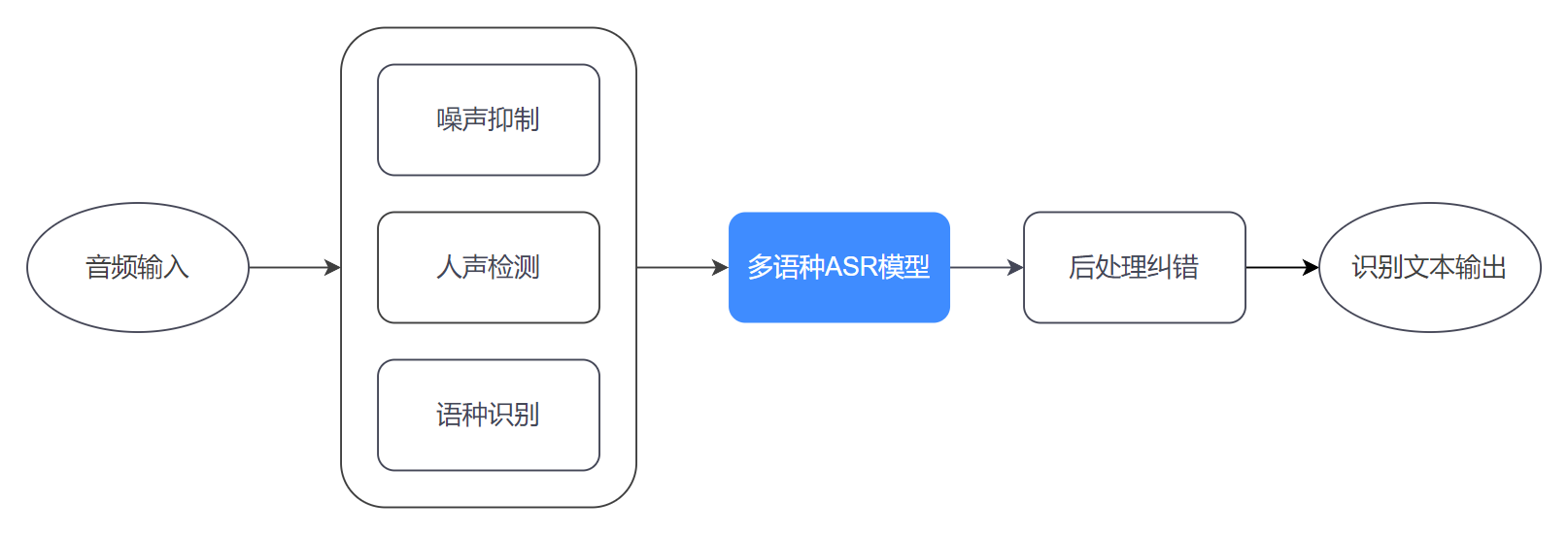
The ASR speech recognition engine utilizes a multi-stage pipeline architecture, where audio requests are preprocessed before entering the model: original audio is purified using noise reduction (ANS), while voice activity detection (VAD) and audio segmentation capture valid speech boundaries and complete input normalization.
After inference with the multilingual ASR model and delay compression plus stability strategies, post-processing calibration is applied to the output text. Semantic correction and formatting polish the output and standardize punctuation, yielding the final recognition results.
ASR Flow Diagram
Integration Guidelines
6.1 Integration Methods
The Service offers two integration methods: SDK integration and standard API integration.
For the complete integration instructions, please refer to: ASR Service Integration.

